


Automation software for Windows: you describe the task in plain language and the AI agent builds the RPA robot on your machine. Connect your Claude account and run the agent on Claude Opus 5.5 within your plan's limits; with Codex, use your account's limits. If the robot breaks, the Curador, Curator's self-healing agent, fixes it.
First month for R$ 125 Discover CuratorPYE Tech pinpoints where your company's key process gets stuck and uses AI agents to build the systems, automations and integrations that unblock the operation, at the speed AI has brought to software development.
Book a diagnosis See a real caseWe connect your systems and your Curator robots to a physical 15-key deck. Monitor, start and read the logs with one press, and see the team's deadlines without opening a single screen.
Discover the deckDeck XL
Keys
Settings
Plugins
Backup
↶ Undo
Mirabox XL 1 connected
From a plain-language request to a robot in production, without switching tools: the AI agent writes the robot in Python and works in the real Google Chrome, the Curador fixes the robot when it breaks, and queues split the work across several machines when volume grows.
You write what the robot should do, the way you would explain it to a colleague. In the "Agente" (Agent) tab, the AI creates, changes and tests the automation in Build mode; in Plan it proposes the approach, and in Chat it only explains. It opens the Google Chrome window connected to Curator and, on Windows, looks at the screen to understand the process.
You click "Executar" (Run) and the robot runs on your company's machine. The "Fluxo do Projeto" (project flow) shows each stage, and the "Execuções" (Runs) tab keeps the history and logs. If the robot breaks with a technical error, the Curador, Curator's self-healing agent, steps in right away: it looks at the screen, decides and fixes it.
When volume reaches thousands of items a day, the work goes into a queue: one shared central list. When you create the automation, you pick a REFRAMEWORK template: the Dispatcher fills the queue, Performers process the items in parallel, and the Disperformer does both in the same project.
The AI agent, the Curador, Google Chrome and Computer Use, document data extraction, queues and triggers in a single app. It is what a team needs to take automation from idea to production and keep it running every day.
In the "Agente" (Agent) tab, you describe the routine and the AI creates, changes and tests the automation. Build edits the code, Plan proposes the path and Chat only explains. It looks at the screen, checks the queue and, once you connect it, reads your classic Outlook email. You are the one who clicks "Executar" (Run).
Connect your Claude account and run the agent on Claude Opus 5.5, Anthropic's flagship model, within the limits of the plan you already pay for. With Codex, use your account's limits. The chat shows "Custo —" (cost —): no per-token billing. You can also use Antigravity or an API key.
Turn the Curador on for an automation ("Ligado nesta automação"). If it breaks with a technical error, the Curador steps in right away: it looks at the screen, decides whether to stop or carry on, and sends an email alert. Then it fixes the code, tests it and reruns the items that broke. Without a confirmed fix, it undoes its changes.
The agent works in the real Google Chrome, linked to Curator by an extension: Curator opens the window and connects on its own. Outside the browser, Computer Use on Windows lets the agent look at the screen and the open windows and take desktop actions.
Interpreters read PDFs, Excel spreadsheets and official letters in visual steps: each step extracts one field with the AI model you choose. Switch one step’s model without rebuilding the rest, and call the interpreter through an API ("Copiar API").
Distributes thousands of items across several robots without duplication: each item is reserved atomically in the database. In the "Filas" (Queues) tab, you follow the pending, successful, failed and abandoned items of each queue.
Create a trigger by time or by new items in a queue, and the automation starts on its own on this computer. In "Execuções" (Runs), every run is logged with its origin (manual or trigger), status, tokens, machine and report.
Runs several AI models on the same task and ranks them by accuracy, so you can pick the model with the best cost and accuracy for each automation based on real numbers.
Invite people to the workspace with the right role: Administrador (admin), Desenvolvedor (developer) or Operador (operator). The "Uso de IA" (AI usage) window shows tokens and calculated cost per model, and "Notificações" (notifications) tell you when new models arrive.
The four tabs of the main window:
Automation Runs Queues AgentAnd in the app's menus and windows:
Curador Triggers Interpreters Benchmark Notifications AI usage Team SettingsReal screens from Curator 3.2.3. From a connected Claude account to a queue in production. Click a screen to enlarge it.
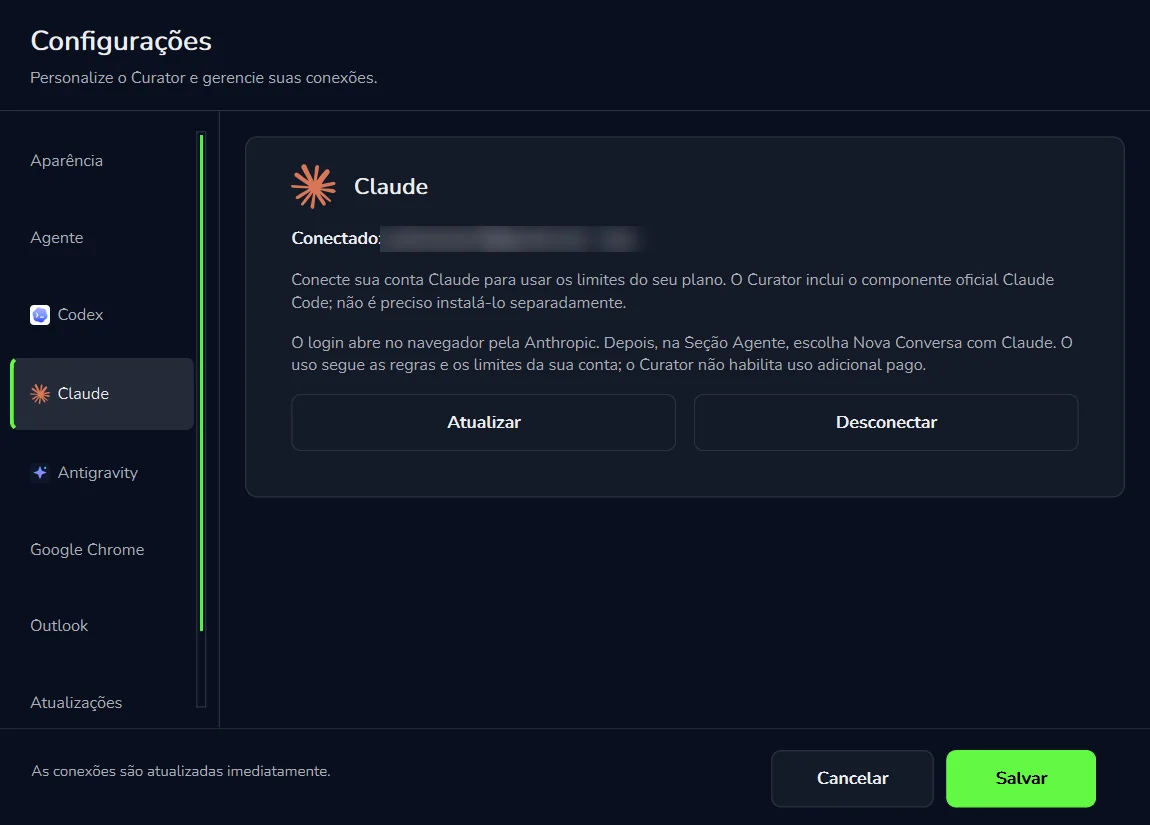
In "Configurações" (Settings), connect Claude and use your plan's limits. Claude Code already comes with Curator.
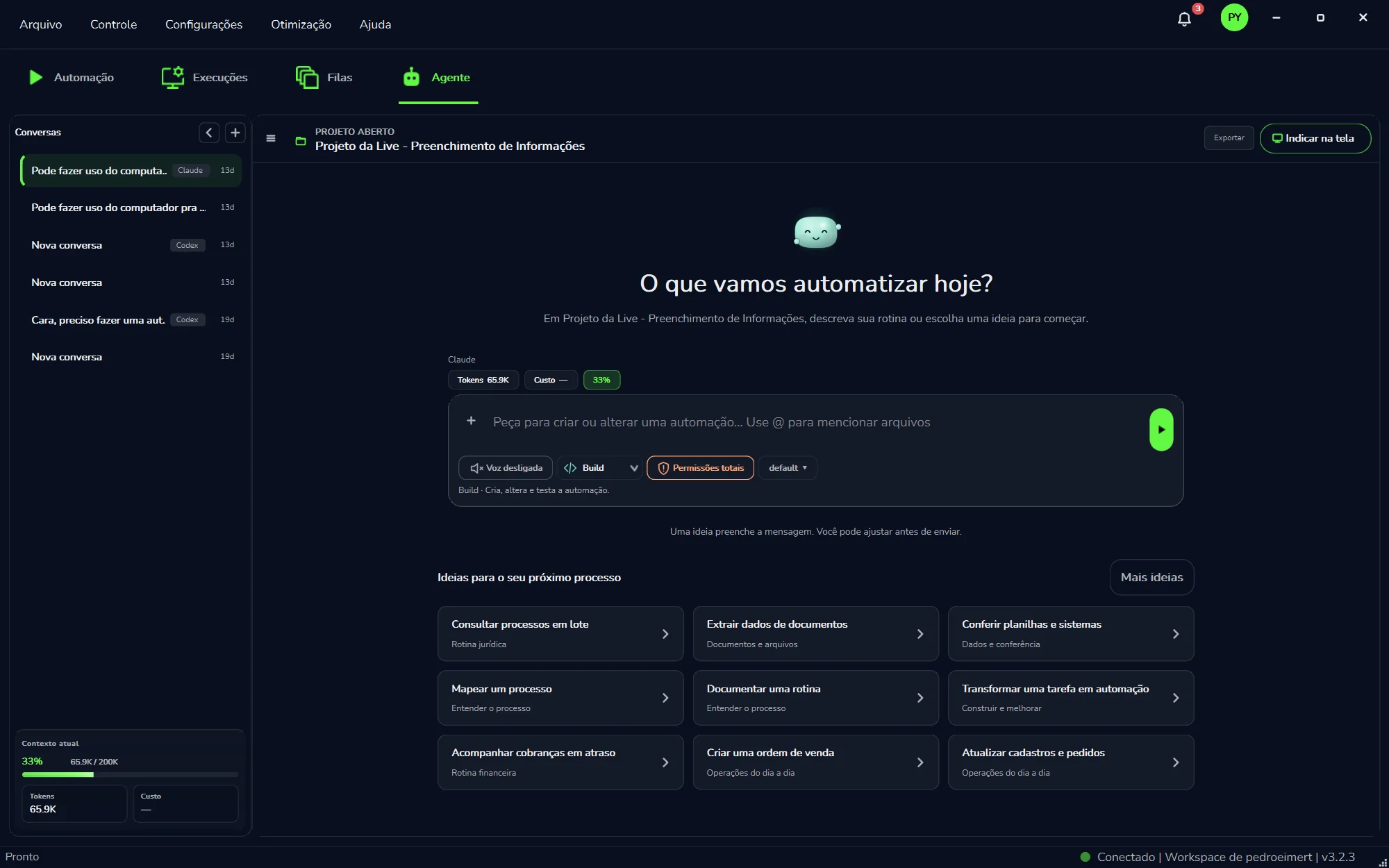
Describe the routine or pick a ready-made idea. With Claude, the chat shows tokens and "Custo —" (cost —).
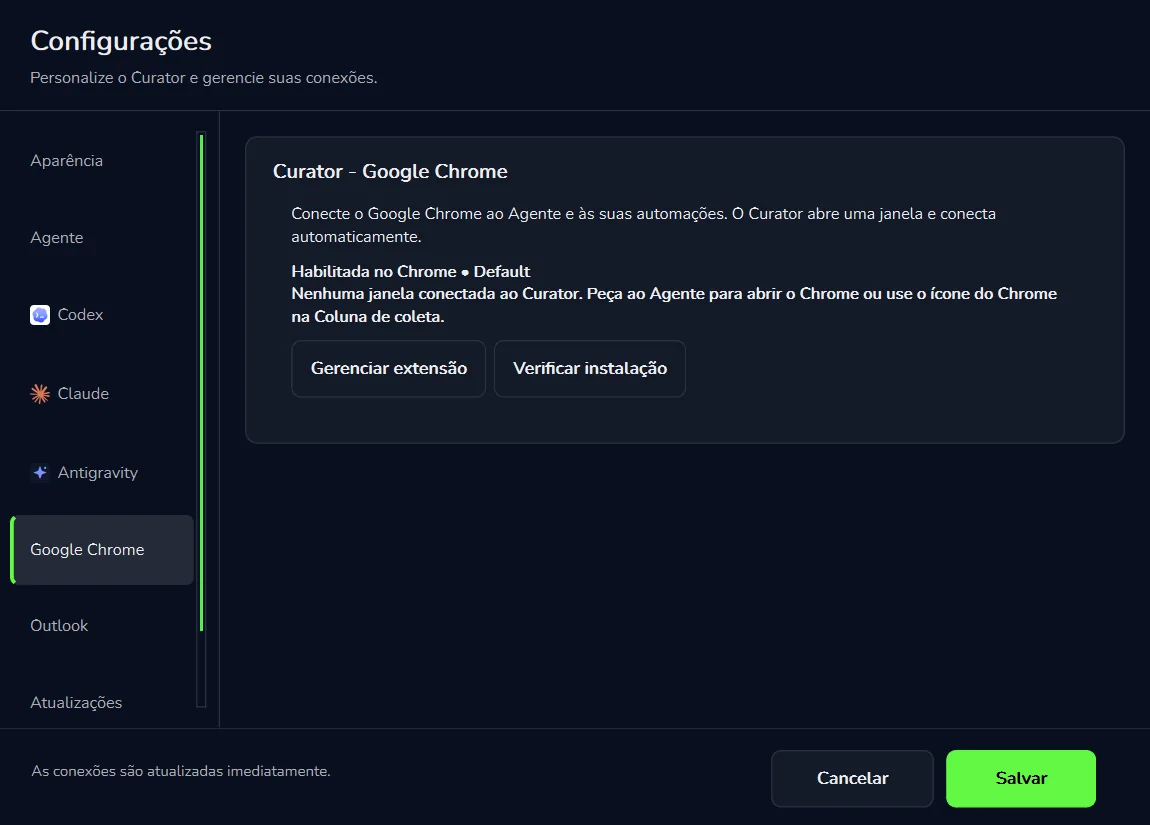
The extension links your Chrome to the Agent and your automations. Curator opens the window and connects on its own.
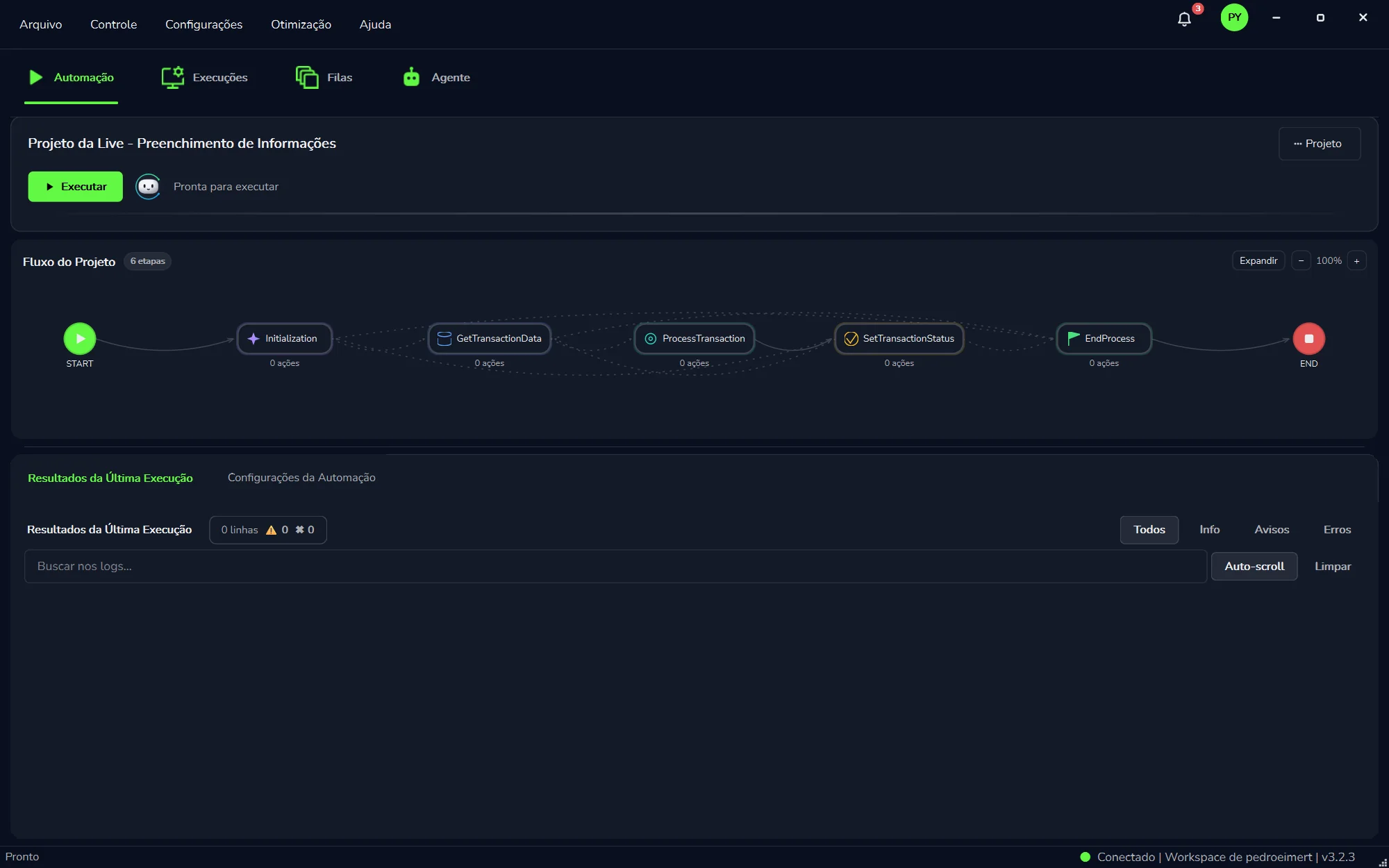
The REFRAMEWORK stages, the "Executar" (Run) button and the last run's results, on one screen.
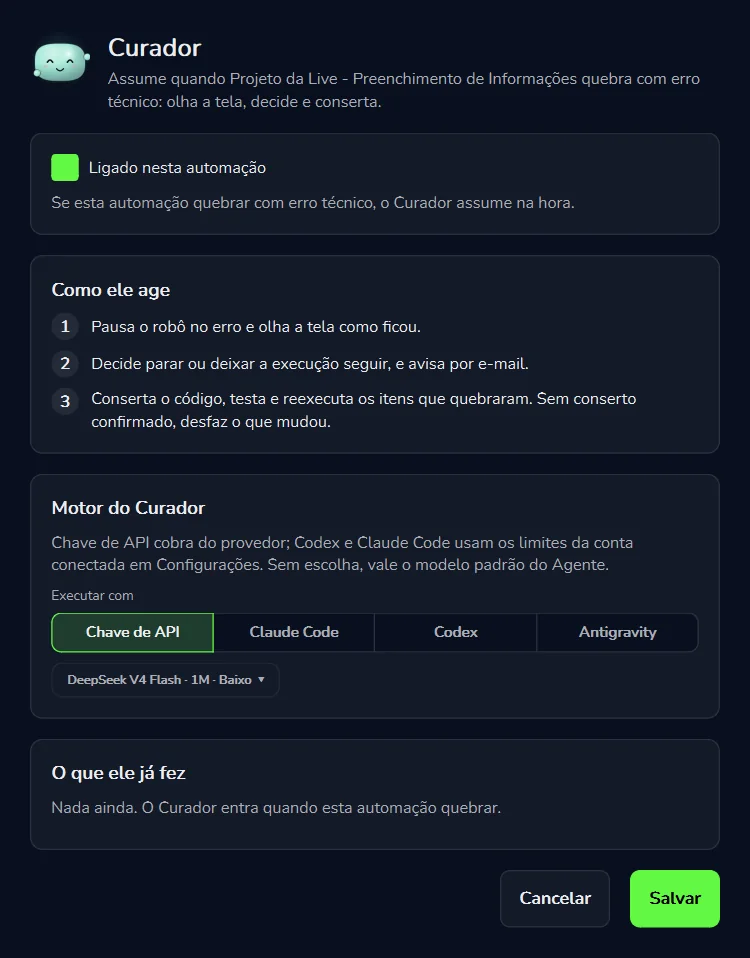
Turned on per automation, with the engine you choose: API key, Claude Code, Codex or Antigravity.
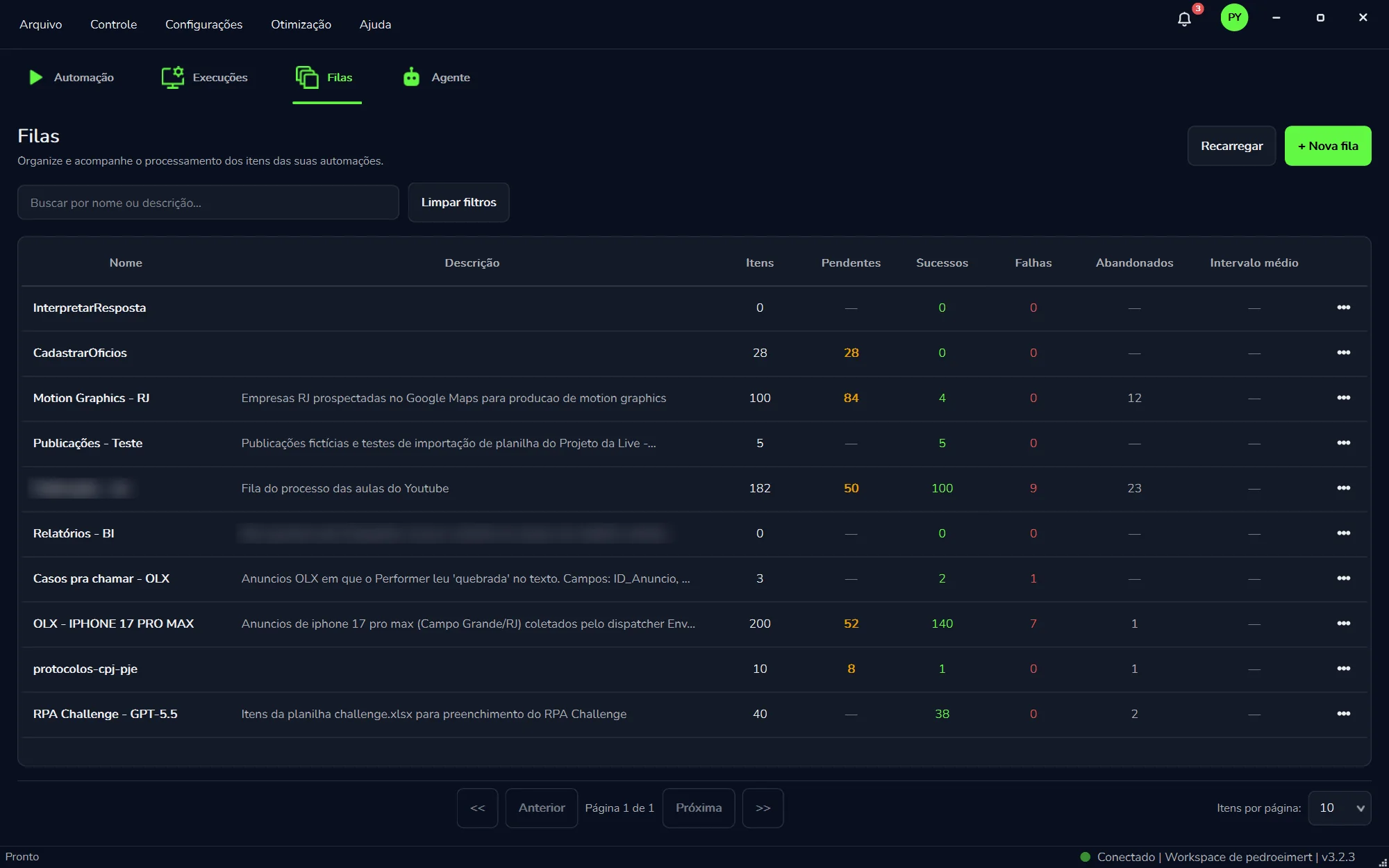
Items, pending, successes, failures and abandoned items for each queue. Several robots, no duplicates.
Process automation touches sensitive data and the company's most critical systems. That is why, in Curator, access control is not an optional add-on: it is switched on from the start.
API keys stay on your computer only: PYE Tech never receives them. With Claude or Codex you don't even need a key: you connect your own account, and the Claude sign-in opens in your browser, through Anthropic.
Connect your Claude, Codex or Antigravity account, or use your own API key with the provider you prefer. The robot operates Google Chrome, Excel, classic Outlook and PDF and CSV files on Windows.
Claude Code Codex Antigravity OpenAI Google Gemini Anthropic Claude xAI DeepSeek Qwen Moonshot Z.AI CompactifAI Google Chrome Classic Outlook Windows Excel PDF CSVNo risky reinvention: Curator relies on the same foundations used by the world's largest automation and artificial intelligence platforms.
Python LangGraph LangChain Supabase PostgreSQL Playwright CloudflareWhat companies ask most before building their first robot.
It means using artificial intelligence so that a software robot handles the repetitive computer tasks that take up your team's time: filling in systems, downloading reports, reading documents and checking data. In PYE Agent Curator, AI also builds the robot: you describe the task in plain language, the AI agent writes the automation and the robot runs it on your machine. If it breaks, the Curador, Curator's self-healing agent, fixes it.
RPA (robotic process automation) follows a fixed script: it clicks, types and copies the same way every time, quickly and predictably. An AI agent receives a goal and decides the next steps. Curator combines both: the AI agent builds and fixes the robot, and the RPA robot runs the routine the same way every day. The monthly and yearly plans also include general-purpose agents, which choose the next step on their own.
No. For high-volume tasks with clear rules, a robot that always follows the same path is usually faster, cheaper and easier to audit than calling an AI model at every click. What AI changed is the rest of the work: it now writes the robot, reads documents with no fixed layout and, through the Curador, fixes the robot that broke.
Not to get started. You describe what the robot should do in the "Agente" (Agent) tab, or pick one of the ready-made ideas, and the AI builds and tests the automation. It works in the real Google Chrome, connected by an extension, and looks at your screen on Windows to understand the process. The robot is written in Python, so anyone who codes can open, review and adjust it. See how the Agent works.
Yes. In "Configurações" (Settings), connect your Claude account (the sign-in opens in your browser, through Anthropic) or your ChatGPT account with Codex. Then, in the "Agente" (Agent) tab, start a "Nova conversa" (new conversation) with Claude or Codex. The agent now uses your plan's limits, and the chat shows "Custo —" (cost —): there is no per-token billing. With Claude, pick Claude Opus 5.5 in the conversation's model picker (it starts on "default", your account's default model): it's Anthropic's flagship model. Curator already ships the official Claude Code component, with no separate install. For Codex, the screen shows how much of your limit is available and when it renews. Curator does not turn on any paid extra usage: your plan's rules apply. See the AI engines.
The Curador is the Curator feature that fixes the robot on its own. You turn it on for each automation ("Ligado nesta automação", on for this automation). If the automation breaks with a technical error, the Curador steps in right away: it pauses the robot at the error and looks at the screen as it was left; it decides whether to stop or let the run carry on, and sends an email alert; then it fixes the code, tests it and reruns the items that broke. Without a confirmed fix, it undoes its changes. You choose the Curador's engine (API key, Claude Code, Codex or Antigravity), and its window shows what it has already done. See how the Curador works.
The monthly plan costs R$ 250 per machine, and the first month is 50% off: R$ 125. Cancel anytime. There is also a weekly plan at R$ 200 per machine for short pilots, and a yearly plan at R$ 2,250 per machine (R$ 187.50 per month). You can pay by credit card, Apple Pay or Google Pay. With your Claude or Codex account connected, the agent uses your plan's limits, with no per-token billing. When you use an API key, model usage is billed directly by the provider. Compare the plans.
Curator's agent runs on four engines: Claude, Codex, Antigravity and API key. With Claude, run the agent on Claude Opus 5.5 within your plan's limits; with Codex, use your account's Codex limits. With an API key, you choose among 9 providers (OpenAI, Google Gemini, Anthropic, xAI, DeepSeek, Qwen, Moonshot, Z.AI and CompactifAI) and pay them per token directly. Each automation, and even each document-reading step, can use a different model. "Notificações" (notifications) tell you when new models arrive, and the Benchmark compares models on the same task.
Robots run on your own machine, and your API keys are stored only there: PYE Tech never receives them. With Claude or Codex, you sign in with your own account. When the agent reads your Outlook email, the data goes to the AI model you selected, and changes to the mailbox ask for your confirmation in the chat. Access uses two-step verification, data such as tax IDs and card numbers is masked in execution summaries, the installer is digitally signed and data handling follows Brazil's data protection law (LGPD).
The best candidates are repetitive computer routines with clear rules and high volume. Common examples: accounts payable, bank reconciliation, invoice checking, downloading reports from portals, data entry into a web-based ERP, reading PDFs and Excel spreadsheets, and sending emails through classic Outlook. PYE Tech has delivered automations for tax, finance, accounting, logistics, HR, legal, manufacturing and insurance brokerages.

Your first month costs R$ 125, with every feature of the monthly plan: unlimited automation runs on your machine, queues at scale, robot publishing to other licensed machines, automatic updates and PYE Tech support. After that, R$ 250 per month per machine, cancel anytime. For the AI, use your own Claude or Codex plan limits.
See plans and get started Read the documentationCurator is our flagship product. For those who would rather have PYE Tech run the project end to end, we still offer the services the company was founded on: from mapping the process to a robot in production.
We analyse your end-to-end workflows to find where automation delivers the highest return.
View detailsWe classify, extract and validate data from invoices, contracts and PDFs using generative AI.
View detailsRobots that carry out repetitive tasks in your systems, from ERPs to government portals.
View detailsYour AI answers based on your own data, without making information up.
View detailsIndustries where we have already delivered automations:
Tax and compliance Insurance brokerages Logistics Finance Human resources Manufacturing Accounting and back office Legal





We track them for you. Subscribe to get every new model as soon as it's released.
We check OpenRouter every hour. Each new model arrives in its own email, with the full spec sheet (emails in Portuguese). Unsubscribe with one click. Privacy policy.
Curator Radar blog
How each new OpenRouter model is being received, with links to news, Reddit, X and Hacker News (posts in Portuguese).
Especialistas ouvidos pela CIOL afirmam que a soberania em IA exige controle sobre dados, redes e capacidade computacional. O Jornal SOL relata que a…
G 25/10/2026 · Geopolítica da IAO panorama reúne propostas eleitorais no Brasil sobre IA, data centers e soberania, além de movimentos de cooperação e competição internacional em IA…
G 24/10/2026 · Geopolítica da IAAs evidências recentes destacam debates sobre soberania e inteligência artificial. A ANTARA News publicou uma análise sobre a construção de soberania…
Lessons in Portuguese, from process automation basics to REFramework: exception handling, dates, arrays and even calling an AI model like DeepSeek inside UiPath Studio.

Leave your email and we will book a diagnosis call: we look at your key process, where it stalls and what can be built first, whether a system, a Curator automation, a deck or the mentoring. You leave with a path forward, even if you don't continue with us.
 Curator

